St Elizabeth of Hungary
Jump to prayer, table suggestions
Elizabeth was born a princess in 1207, daughter of King Andrew II and Queen Gertrude of Hungary, and niece to Duchess Hedwig of Silesia (today known as St Hedwig). As was the custom at the time, Elizabeth’s marriage to a neighboring prince was arranged far in advance, as a way to unite the countries politically. So as a young girl, Elizabeth moved to Germany to be raised alongside her future husband, Louis IV. She also lost her mother to political violence at age six.
Her childhood in the German court was one of extravagantly wealthy castle life; but amid the royal treatment, she was also known to be a very prayerful child, devoted to God. Although the marriage was arranged, she was said to have grown to be very dear friends with Louis by the time they became king and queen.
As queen, she was very sensitive to the needs of the poor in her kingdom, and preferred simplicity to lavish feasts. She would often go out from the castle with her maids and personally give out food and clothes and other things that the poor people needed. This at times caused people in the royal court to gossip and slander her, but King Louis was a constant defender of his queen’s Christian ways. The couple had three children together.
In about 1223, Franciscan friars (of the very newly formed order) came to Elizabeth’s court, and she took on a Franciscan spiritual director. Later his reflections on her faith and the miracles she performed would play a big role in Elizabeth’s canonization.
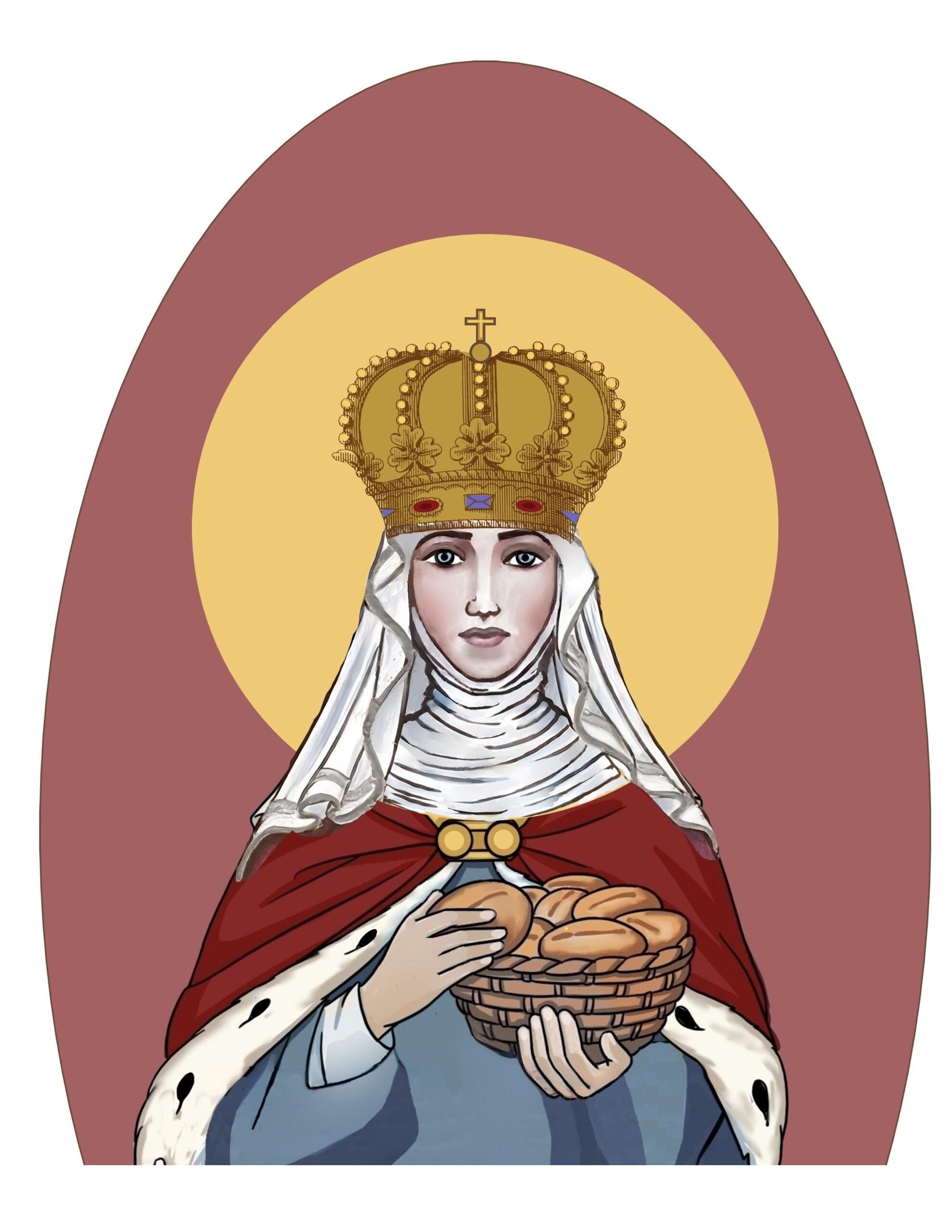
King Louis IV died at the age of 26 on a crusade to the Holy Land when Elizabeth was pregnant with their third child. She later took on a grey Franciscan habit, gathered a small community of other Franciscan laywomen, and joined in the order’s corporal works of mercy—even using her dowry to start a hospital in Marburg. Today she is considered patroness of Third Order Franciscans, as well as such groups as bakers, brides, charity workers, and widows.
Prayer for your Table
Christ the King,
You gave Catherine a heart for service and compassion.
We thank you for her example of care for the poor
when it would have been so easy for her to turn a blind eye
and simply relish in the royal life she had been born into.
We ask you to ignite in us a passion for helping those in need
and to help us remember that royalty is best seen as service
just as you, Jesus, washed the feet of your disciples to show them the way.
In gratitude and praise,
Amen.
Table Suggestions
One famous story about St Catherine is that she was once out in a surrounding village to hand out bread, and was asked by some of her husband’s court to show what she was carrying in her cloak. (This questioning was possibly motivated by gossip that she had been stealing from the castle to give to the townspeople). When she obliged and opened it, instead of bread, white and roses fell out. So for today’s feast, you could take these elements of roses, bread, and royalty and add them to your meal in a variety of ways, for example:
- Make or buy rolls and have a family member carry them to the table inside an apron for serving.
- Draw red roses on white napkins to be used as part of the table setting, or look for cloth napkins with a rose design.
- Buy roses (real or artificial) to be used as a centerpiece.
- Search for an online tutorial and fold ribbon roses out of wired ribbon, to be used as table decor, or to be passed around as a marker of who “has the mic” during dinner discussion.
- Wear crowns during your meal, either from your dress-up bin or made out of paper and aluminum foil. Everyone could wear one, or you could use one crown and have that be the “my turn to talk” indicator.
Upcoming in the Liturgical Year
St Elizabeth of Hungary
January 1, 2027

Pentecost
May 16, 2027

The Feast of The Blessed Virgin Mary, Mother of the Church
May 17, 2027